

In the year since I last wrote about the experience of living in an impossible body as an intersex person—one legal systems do not understand and medical systems try to erase—there has been a rapid increase in efforts to legalize this erasure of intersex people in every way possible. Between January 1st and October 26th, 2025, the ACLU tracked over 600 anti-LGBTQ bills in the US. While the specific policies proposed vary, nearly all of these bills are based on the claim that human sex is a definable, provable binary.
Their idea of human sex holds no place for intersex bodies that vary from strict, binary understandings of sex. These claims and definitions are being used to prop up and justify increasing regulation and repression of education, healthcare, identification documents, athletics, public speech, bathroom and locker rooms, drag performances, and more.
Whether directly or indirectly, every one of these bills impacts intersex people. These legal and political attacks attempt to expand the unsuccessful yet deeply harmful work of John Money, who introduced the medical model of operating on intersex children under the premise that such surgeries could determine a child’s sex and make intersex children grow up to be non-intersex men and women. His work led to the ongoing practice of intersex “normalization” surgery- which attempts to make intersex an impossibility by erasing intersex bodies altogether.
My urgent invitation
As we commemorate Intersex Awareness Day 2025 in this chaotic and relentless historical moment, I am offering an urgent invitation, particularly to people who are not intersex. I am not offering an invitation for you to read a list of facts or check off a set of activities about intersex awareness (as I am a firm believer that awareness alone will not save us), but an invitation to become disoriented around sex.
Why is disorientation important? Sara Ahmed, a feminist scholar, writes about how becoming disoriented can enable us to become oriented to the world and ourselves in new and transformative ways.
What might this look like? Imagine you are standing upright. You know that the word for what you are doing is “standing,” but you do not fully realize what standing means until something causes you to fall down. The fall is disorienting, but you learn things along the way—about being upright, being on the ground, navigating the space between them. When you fall and return to standing, you gain a new understanding of what it means to stand. You know how to get back up again. By becoming disoriented, you become newly and more deeply oriented; you understand the world in ways you have not before.
There are many ways of becoming disoriented. Realizing that the body you were born into is impossible (according to everything you have been taught) is one of them.
My body was disorienting
I came into the world being told that I was a girl and that someday I would go through puberty and become a woman. I had a book with pictures of what the different stages of puberty would look like, and in 5th grade, they gave everyone sticks of deodorant. One scent for the girls, and a different scent for the boys. Everyone knew that the future of our bodies was already determined, neat and inevitable.
If you had asked me then, I could have told you the word for this was “sex” or maybe “gender.” I did not fully realize what those things meant until my body had other plans, did other things, refused to match the pictures in the puberty book or any version of “woman” that I had ever been told could be possible.
What happened to me was disorienting, like falling from standing. And just as falling can teach us new things about standing, it forced me to see the world in a new way. When my body developed differently, I fell out of a story I hadn’t known existed, a story of a sex/gender binary that shaped everything about who I had been told I was and what I was told I would inevitably become.
How do you stand up after falling down out of a story that you thought was the entire world? For me, I had to learn about a world beyond the story, one in which I and my intersex body could be possible. This experience of disorientation has oriented me in new ways. I learned that the sex / gender binary isn’t a biological truth, but a set of societal expectations and laws built on specific histories and systems. I learned that, in spite of what these social expectations and laws have attempted to enforce, there have always been sex and gender non-conforming people like me. My learning (and unlearning) is never over, and I will continue to encounter challenges to the stories I learned about the world.
Disrupt the sex binary with me

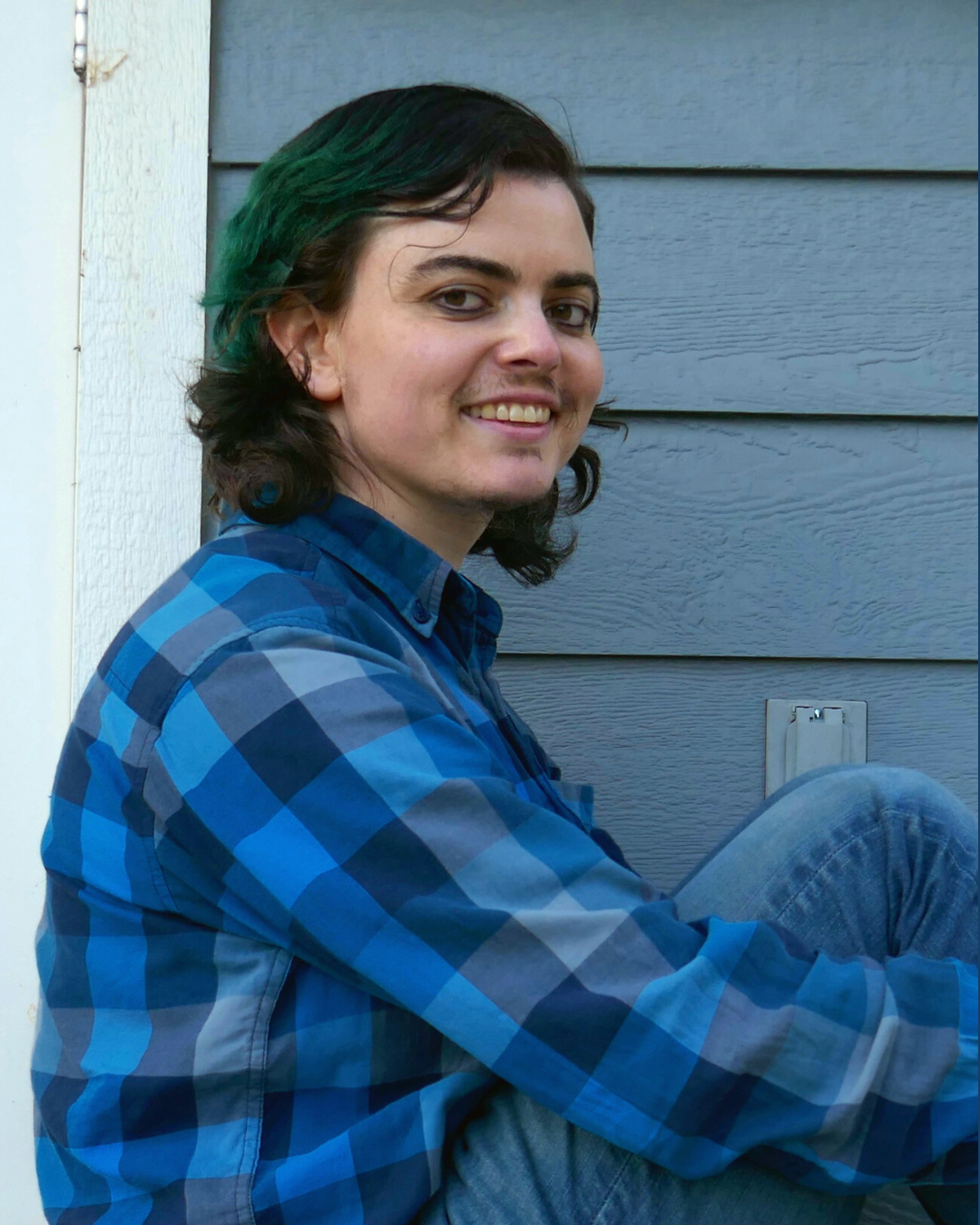
Sam Shape and Ly Baumgardt of TIGERRS with the intersex flag
I invite you to join me in becoming disoriented around sex, even if, unlike me, you have the option not to. Becoming disoriented around sex is more than memorizing a tidy set of facts about intersex awareness and calling it a day. Instead, I want you to learn how to see and challenge the social story of the sex/gender binary in all of the ways it shapes our lives.
There is no checklist. This is your own process of disorientation and orientation, and I cannot do it for you. You need to learn to see and respond to the story, everywhere you notice an assumed sex and gender binary. This binary erases and oppresses intersex people—and to some degree, all people. I’ve yet to meet a person who hasn’t at least once been made to feel ashamed or wrong or inadequate by the artificial and relentless expectations around sex and gender that are forced on us.
What view of the world would you need to be able to disrupt stigmatizing jokes about hairy women, or men with no testicles, whenever you hear them? How can you be oriented to include intersex people when naming and fighting the harms of anti-trans legislation, and correct someone when they confuse transgender and intersex? To tell your friends when you see an earthworm that the earthworm, too, is intersex, and that nature is full of organisms that are neither, other, or both male and female? What would it take to allow yourself to heal from the ways that the sex/gender binary has inevitably made you feel less than and limited, whether you are intersex or not? What, beyond just awareness, would you need to get there?
I invite you to become disoriented around sex because disorientation can cause us to learn, unlearn, think, rethink, and challenge the very foundations of what we thought to be true. This is more important than ever, not only around sex. The attempts to ever more aggressively legislate the sex binary, and make intersex bodies seem impossible, are just two of the multitude of authoritarian tools being deployed to repress human diversity and enforce harmful binaries at the expense of everyone.
We can’t just return to how things were a few years ago, or limit ourselves to trying to reverse the newest and worst of the policies targeting marginalized populations. Instead, we have to question the underlying systems, assumptions, histories, and oppressive stories that have brought us to this point and limited the worlds we can imagine.
This urgent historical moment requires that we all face disorientation, that we fall out of stories that confine and harm and divide us. On Intersex Awareness Day, I offer us all this invitation as an opportunity to collectively question, imagine, and create new ways of being and caring and fighting for each other, beyond what could have seemed possible within our previous orientations.
Sam’s words remind us how powerful it is when intersex people speak truth to power—and how vital it is that they’re resourced to keep doing so.
At interACT, allyship means action. That’s why intersex voices like Sam’s are compensated for their writing—because their time, labor, and leadership fuel this movement.
Stand with intersex youth this Intersex Awareness Day: make a donation today to help resource their voices and sustain their advocacy.