

Intersex Legislation and Regulation
Guided by the needs of intersex children and youth, our Law and Policy team advises local, state, and federal agencies on how best to protect the rights of children born with intersex traits. Drafting policy documents, assisting in implementation of intersex-inclusive programs, and providing comment on legislation that impacts the realities of intersex young people—these are just some ways interACT works to improve the lives of intersex youth across the country.
Read about interACT’s work on various policies below.
National Intersex Legislation, Laws and Policies
Congressional Intersex Awareness Day Resolution
Since 2023, interACT has supported the introduction of the U.S. House of Representatives’ annual resolution acknowledging Intersex Awareness Day. These resolutions are historic in that they describe the harms of nonconsensual and unnecessary interventions on the bodies of intersex infants and young children, call on public officials and providers to prioritize intersex health equity and human rights, and reject rigid binary definitions of biological sex as both unscientific and dehumanizing.
U.S. Equality Act
In 2019, interACT’s advocacy led to the first-ever inclusion of intersex anti-discrimination protections in federal civil rights legislation. The Equality Act would amend the Civil Rights Act to make it illegal to discriminate on the basis of sex, including a person’s intersex traits, in employment, housing, schools, public accommodations, and more. Since 2019, the intersex-inclusive version has been passed twice by the U.S. House of Representatives, and has been reintroduced by members of the Congressional Equality Caucus in every Congress.
Featured Resource
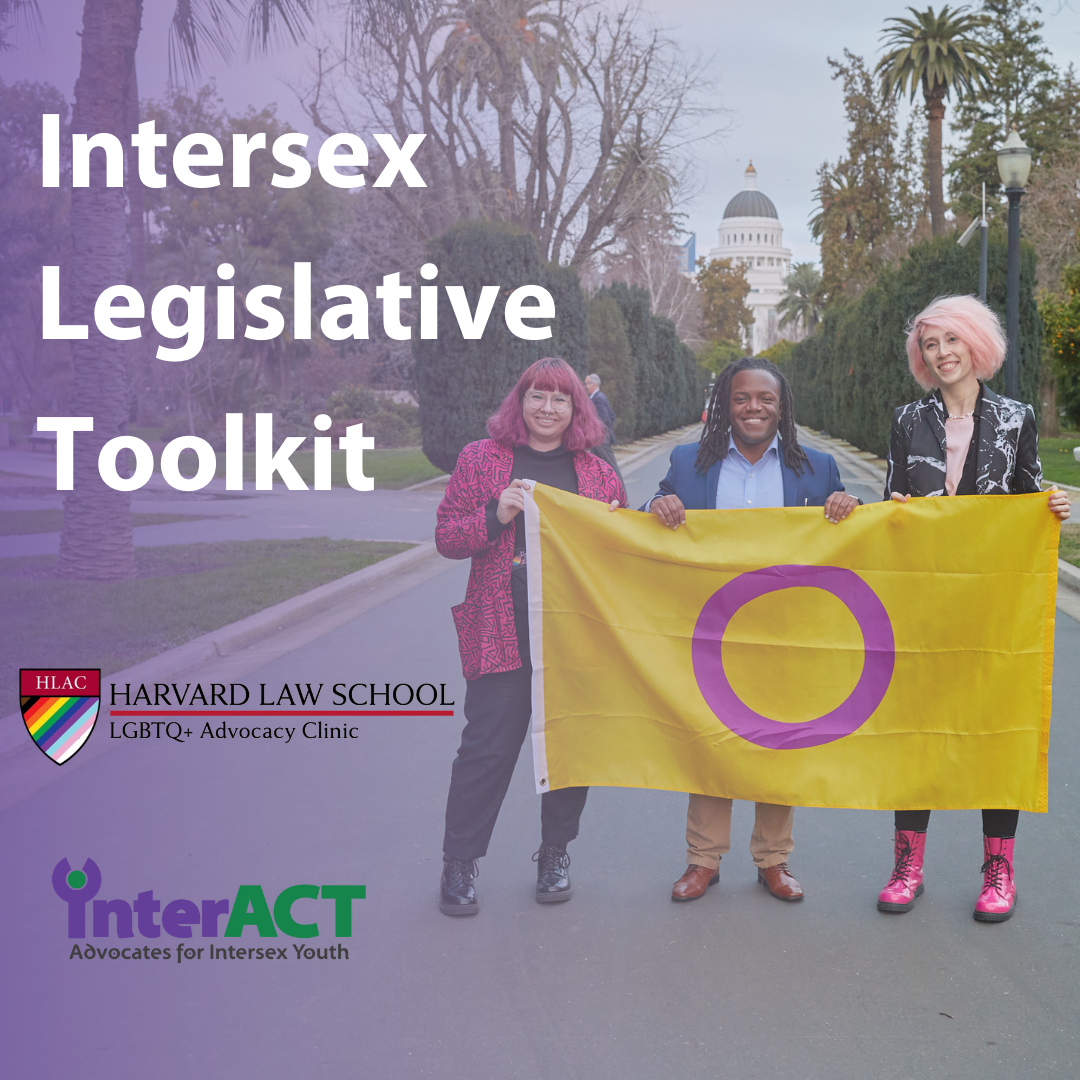
Co-created with Harvard Law School, the Intersex Legislative Advocacy Toolkit provides resources and guidance to activists who are seeking to end the practice of performing medically unnecessary surgeries on intersex children.
Intersex Discrimination in Healthcare
In 2016, as a result of comments submitted by interACT, the US Department of Health and Human Services added language to the final rule implementing the Affordable Care Act’s prohibition on sex discrimination in federally funded health programs clarifying that discrimination on the basis of intersex traits is discrimination on the basis of sex. This was the first time the federal government specifically acknowledged that legal protections apply to intersex people, too.
The history of this regulation is complicated. interACT later submitted comments to the Department of Health and Human Services against a new proposed regulation that would allow religious discrimination in healthcare settings that could impact intersex individuals’ ability to receive care. The regulation was then rewritten in 2020 to reverse all of the protections extended in 2016, and in 2024, intersex and other protections were explicitly reinstated in a new rule. While some of those protections were challenged in court and abandoned by the Department of Health and Human Services in June 2026, the protections for intersex people remain in place
State Level Intersex Legislation, Laws and Policies
New York State Public Health Education Campaign Law
In November 2023, on the Intersex Day of Solidarity, New York enacted a law establishing a statewide, community-informed public health education campaign about the harmful impacts of nonconsensual and medically unnecessary treatments on infants and children with intersex variations. interACT worked with local partners to press New York to become the first state to adopt such a law, and is working with the state on implementation. Similar efforts are ongoing in other states.
2021-2022: Rhode Island’s HB 6171
In January 2021, HB 6171 was introduced in Rhode Island. HB 6171—or the Protection of Youth with Variations in Physical Sex Characteristics Act—aims to prohibit genital surgeries on intersex children until they are at least twelve years of age and can participate in the decision. This bill aims to ensure that life-altering choices are not being made without the consent of those involved.
On April 13th, 2021 the Committee recommended that HB 6171 be held for further study and, as such, the bill is currently postponed.
Read about HB 6171:
- Bill text: HB 6171 legislative text
- Fact sheet: FAQ about HB 6171
2021-2022: California’s SB 225
In January 2021, interACT launched SB 225—or the Bodily Autonomy, Dignity and Choice Act—a new bill working to promote bodily autonomy on genital surgeries. SB 225, which builds off of both SB 201 and SCR 110, was introduced by Senator Scott Weiner and co-sponsored by Equality California, The ACLU of California, and The National Center for Lesbian Rights.
With the ultimate goal of providing children and their families a chance to make informed decisions about major surgeries that too often happen without consent, SB 225 specifies that elective surgeries on intersex children will be postponed until the child in question is at least six years of age and can participate in the decision.
In April 2021, Senator Scott Weiner decided to withdraw SB 225 from committee as it did not have enough support in the Business and Professions Committee to pass. The bill will be up for a committee vote in January 2022.
Read about SB 225:
- Bill text: SB 225 legislative text
- Fact sheet: SB 225 Talking Points
- them: California Could Be First State to Ban Non-Consensual Surgeries on Intersex Babies
- AP/Washington Post: California bill would ban intersex surgery for young kids
- Public News Service: New CA Bill Would Limit Genital Surgeries on Intersex Infants
2019-2020: California’s SB 201
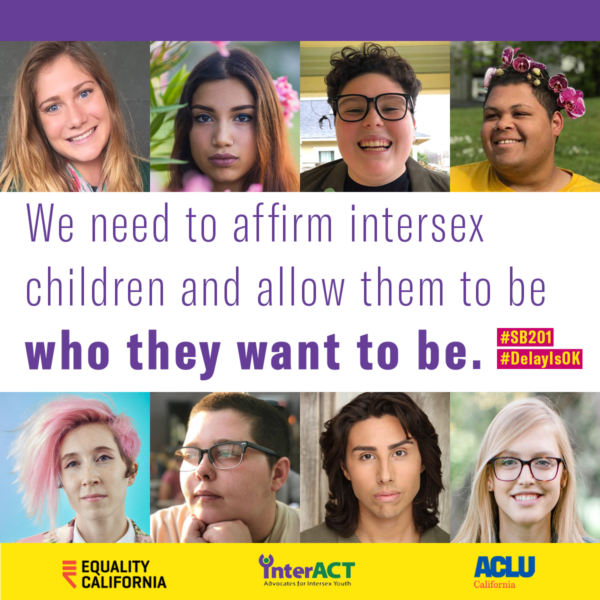
A graphic supporting California’s SB 201, which would have required the delay of forced surgeries on infants’ intersex traits.
SB 201, co-sponsored by interACT, Equality California, and the ACLU of California, would have ensured that individuals with variations in sex characteristics were given the opportunity to provide informed consent before any medical procedures that could irreversibly affect puberty, sexual function, or fertility, including reducing a clitoris, creating a vagina, or removing healthy gonadal tissue.
The bill was announced in 2019, and delayed to 2020 after opposition from urology and parents’ rights groups. interACT brought together a coalition of groups focused on LGBTQIA rights, civil rights, children’s rights, reproductive rights, and other issue areas to fight for an inclusive bill. Many intersex people and allies bravely traveled to testify.
In the end, four members of the California Senate Business and Professions Committee voted against SB 201. Three abstained, and only two voted yes. SB 201 was not advanced, shortly after the chair of the committee received a $50,000 donation from the California Medical Association.
Read about SB 201:
- Bill text: SB 201 legislative text
- Press release: SB 201 announcement and press kit
- Video: Press conference launch of SB 201 in San Francisco
- Video: January 2020 hearing in which SB 201 is not advanced
- Radio interview: Should CA ban nonconsensual ‘medically unnecessary’ surgery on intersex minors?
- Article in the LA Times: Legislation to ban surgery on intersex children fails in California Senate committee
- Article in the San Francisco Chronicle: Major LGBT group revokes endorsement of Bay Area lawmaker over intersex bill
2018: Passage of California State Senate Concurrent Resolution 110
interACT is incredibly proud to have partnered with Senator Wiener and Equality California to have sponsored a resolution supporting the bodily autonomy of intersex youth. California State Senate Concurrent Resolution 110 calls on the medical community to delay nonconsensual and irreversible surgeries until an intersex person reaches the age of informed consent. SCR-110, a non-binding resolution, passed in 2018.
-
- Resolution text: California State Senate Concurrent Resolution 110
- Press release: from the office of Senator Scott Wiener (D-San Francisco)
EBAR: UCSF called out over intersex surgeries
Re.Wire News: Intersex People Want to End Nonconsensual Surgeries. A California Resolution Is Their ‘Warning Shot.’
USA Today: California becomes the first state to condemn surgeries on intersex children
2017: Support for California’s SB 179, Nonbinary Markers on State Documents
interACT supported the Intersex & Genderqueer Recognition Project in drafting revisions to California’s SB 179, allowing California residents to choose a nonbinary gender marker on their state-issued driver’s licenses and birth certificates. The bill was signed into law on October 16, 2017. Read more via Mic and Buzzfeed.
2017: Support of Nevada’s HB408
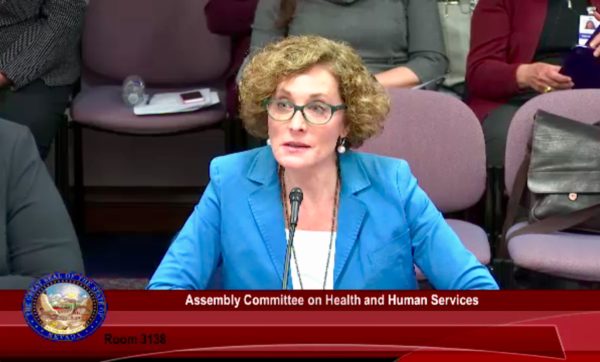
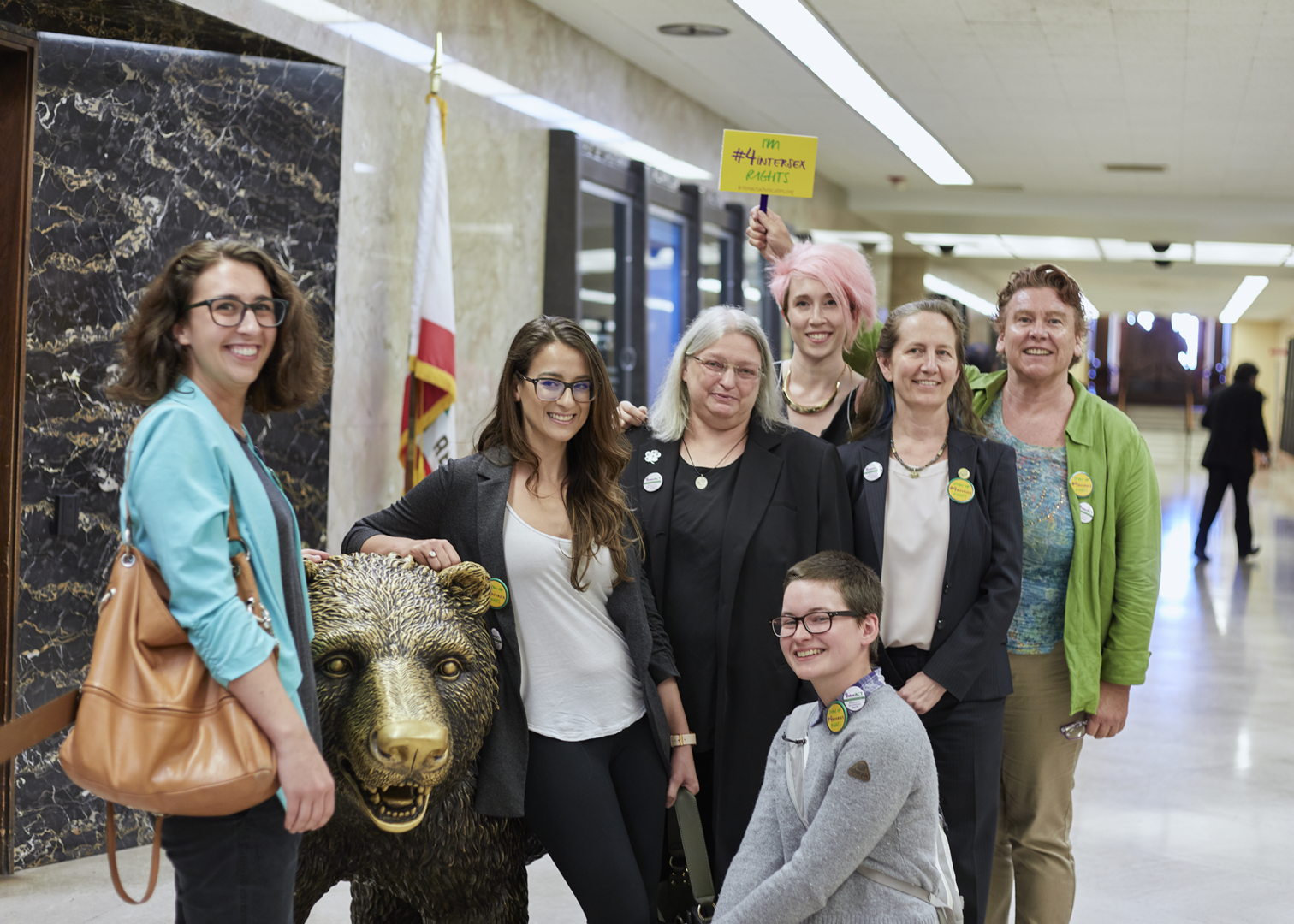
interACT Board member and medical research chair Arlene Baratz testifies in Nevada in support of intersex rights.
In 2017 interACT supported colleagues from Gender Justice Nevada in drafting SENATE BILL NO. 408. interACT Board president Georgiann Davis, Board member and Medical Advisory Group member Arlene Baratz, and interACT Youth member Hans Lindahl provided in-person testimony on the bill, although it ultimately did not advance.
2016: Work Against “Bathroom Bills” and Legislation That Polices Gender
interACT has called for an end to all efforts to force transgender and gender-variant individuals into segregated facilities without their consent as a result of a sex classification on a government-issued document. We have released official statements and sent letters to government officials in response to these “bathroom bills” that waste government resources and negatively impact all of our communities.
Our interACT youth members have spoken out against these bills to stand in solidarity with the transgender and gender-variant communities.
2016: Work Against South Dakota’s Anti-Transgender House Bill 1008
On February 18th of 2016, interACT sent a direct response to South Dakota Gov. Dennis Daugaard urging him to veto House Bill 1008. The South Dakota State Senate sent the bill to the Governor on Tuesday, February 18th. If signed, the legislation would have enabled discrimination against transgender students in public schools and become the United States’ first anti-trans “papers to pee” law.
interACT was in strict opposition to the bill and used the letter to Gov. Daugaard to clarify a number of crucial points about the bill’s impact. Republican Governor Dennis Daugaard had an initial positive reaction to the bill, but on March 1, 2016 he rejected House Bill 1008 after many social justice groups and human rights advocates voiced opposition and declared it was discriminatory.
2016: Work Against North Carolina’s House Bill 2
interACT’s official response to HB 2, sent on March 25th of 2016, called for an end to all efforts to force transgender and gender-variant individuals into segregated facilities without their consent as a result of a sex classification on a government-issued document. These efforts waste government resources and negatively impact all of our communities.
HB2 was proposed, debated, voted on by both legislative branches, and signed by the governor in one day. This bill caused many of our LGBTQI friends in North Carolina to lose all protections and some intersex people to no longer be able to legally enter a public bathroom in the state of North Carolina. Discrimination should not come at the hands of the state.
Local Level Intersex Legislation, Laws and Policies
New York City Anti-Discrimination Protections
New York City’s Commission on Human Rights is tasked with enforcement and education of the New York City human rights laws. Following interACT’s advocacy in 2015, the Commission explained in its guidance that it interpreted the New York City Human Rights Law to prohibit “discrimination against someone for being intersex”. This was one of the first recognitions of intersex discrimination as a prohibited activity under a city human rights law, and it represented a victory for all intersex people. These protections cover hundreds of thousands of intersex people who live in, work in, or visit New York City.
In 2025, interACT supported the introduction of New York City Council legislation that would formalize these protections clearly in city law. With civil rights under unprecedented attack nationwide, it is more important than ever for protections to be made explicit and permanent in the law – and when it passes, New York will be the first city in the U.S. to make plain in the text of its civil or human rights law its commitment to ensure that intersex people can live our lives free from discrimination.
2021: New York City Public Health Education Campaign Law
After two years of advocacy from interACT and partners, the New York City council passed a law requiring the city’s public health officials to develop an education campaign on forced surgeries on intersex infants. Aimed at raising awareness among parents, providers, and the general public, this first-of-its-kind initiative mandated intersex community input into the content of campaign materials. The law was part of a multi-prong effort by NYC officials to support the health and bodily autonomy of intersex children that also included the NYC Health & Hospitals policy banning the practice of nonconsensual and medical unnecessary surgery on intersex infants and young children.