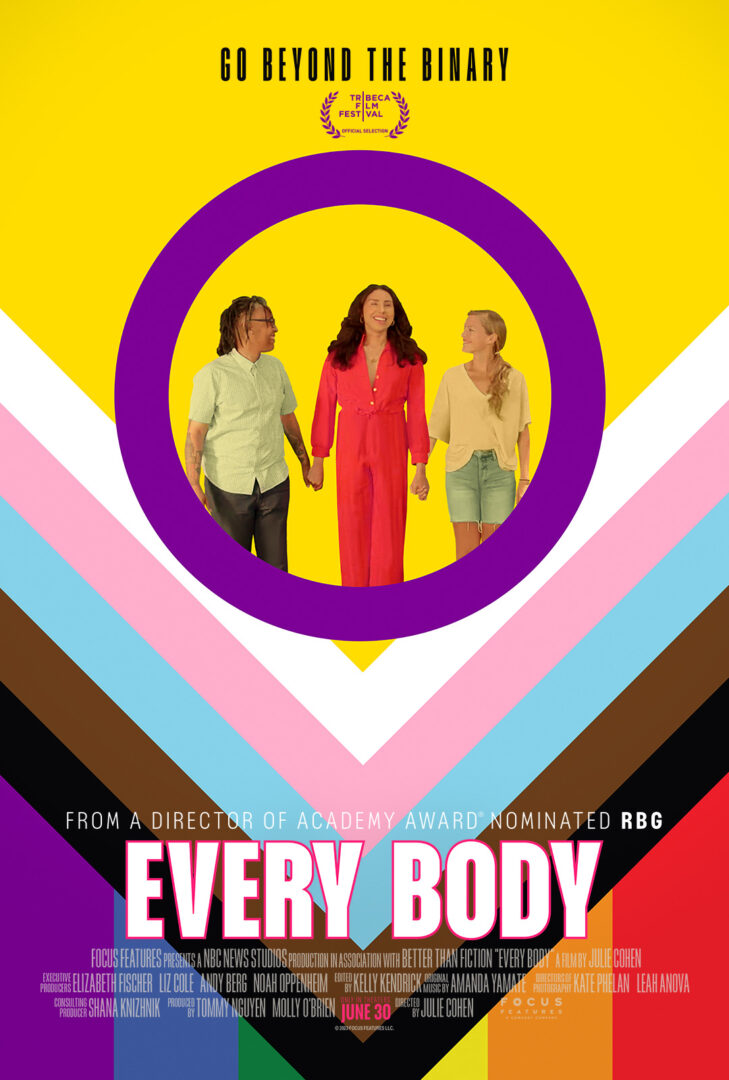

For a long time in the U.S., the vast majority of people with intersex variations went unnoticed by legal, religious or medical establishments. Most people with atypical traits lived average lives, either because their variation was undetectable or not considered especially important. When a sex could not easily be assigned for a newborn, midwives, grandmothers, and other local elders appear to have assigned the sex.
Beginning in the late nineteenth century, doctors learned that atypical sex traits were actually quite common. Because most medical experts were politically conservative and wanted to keep sex borders clearly defined to combat open homosexuality and the rise of feminism, intersex caused them notable stress. Biomedical specialists devised a system that would label everyone “truly male” or “truly female.”
Doctors created an arbitrary standard based on gonads, identifying people as male or female “pseudo-hermaphrodites” or rarely, “true hermaphrodites” with ovarian and testicular tissue. (Note: this term is no longer in use.) Aside from “true hermaphrodites,” all others were considered truly male or female and told to act sexually and normatively in their assigned gender. Improved medical techniques and increased access to healthcare meant many people were diagnosed with a biological “true sex” that made no sense socially, such as women with internal testes.
By the 1920s, experts treating intersex people developed a notion of gender as a social role, separate from biological sex. Doctors began to offer more surgical “corrections” to bring the biological sex into line with the assigned gender. The motivation remained the same: two rigid, binary sex categories.
The start of intersex surgeries
A small percentage of patients with intersex children had started to ask for, and some surgeons had started to offer, surgical reconstruction of large clitorises, small vaginas, and hypospadic penises. With the exception of the rare clitorectomy performed on a child because she had a large clitoris, most of the genital surgeries performed for cosmetic reasons in the nineteenth century were performed on adults at their request. Both patients and surgeons generally avoided elective surgery for safety reasons. There is also reason to believe that most people with intersex were socially healthy without surgery; they did not disproportionately live as hermits or attempt suicide.
For a small number of people with intersex variations—namely those at risk for gonadal cancers and salt-wasting—the medicalization of intersex probably improved their health, sometimes even saving their lives. But most treatments were social concerns.
In the 1950s, Johns Hopkins University became the first medical center to offer an organized multi-disciplinary approach to intersex variations, one that sought to essentially eliminate intersex traits in early childhood through social and surgical means. Because of the belief that it was harder to surgically engineer a boy than a girl, most intersex children were feminized through cliterectomies and vaginal construction, endocrinology, and psychology. A successful patient was one judged to be stable, cisgender, and heterosexual—“normal.” Though the team advocated honesty with the intersex child, in practice many patients were lied to about their intersex traits and gender assignment. As in most of medicine, doctors made the decisions for patients.
David Reimer and the criticism against intersex surgery
A psychologist named John Money was the springboard for widespread nonconsensual intersex surgeries. Dr. Money argued that gender identity was largely mutable early in life, and that nurture was more important than nature. He backed up this claim with a patient, David Reimer, who was born an identical twin (not intersex) boy in 1965. While performing a circumcision, a doctor accidentally burned off eight-month-old David’s penis. David’s parents consulted with the team at Hopkins, and Money recommended they change the sex and gender of their child and raise David as a girl.
For decades, Money erroneously touted a successful outcome because the child reportedly had become a normal, female-identified, heterosexual girl. The truth was that David had never felt fully female. Indeed, when his parents told him the truth about what happened to him, he immediately re-assumed the gender role of a man. Dr. Milton Diamond, a psychologist working at the same time, campaigned fearlessly against Money to dissuade doctors from operating on children with genital differences. Dr. Diamond contacted David Reimer (then a married man in his late 20s), who agreed to publish his story in the hopes that others would not experience what he did.
However, the surgeries continued. Surgeons and psychologists liked the theory because it signified they were providing good care to “abnormal” children. A society rife with homophobia found comfort in the idea that children’s bodies could be conformed into cisgender, straight, normative appearances. But some people didn’t like this system: people who—like David Reimer—felt mistreated at best, and medically assaulted at worst, by their medical treatment. Nevertheless, most stayed silent, believing they were alone in their experiences.
When did the intersex movement begin?
Despite many intersex people being told they were rare and would never meet others like them, the doctors who sent that message were soon proved impossibly wrong. In 1993, feminist biologist Anne Fausto-Sterling published articles in The Sciences and The New York Times exposing the basic fact that intersex exists. In response, Cheryl Chase (who also goes by Bo Laurent) founded the Intersex Society of North America (ISNA). She founded the group because of her own attempts to recover her history of sex-reassignment in infancy and medically-induced shame, and because of the disinterest of most of her former care providers in what had happened to her.
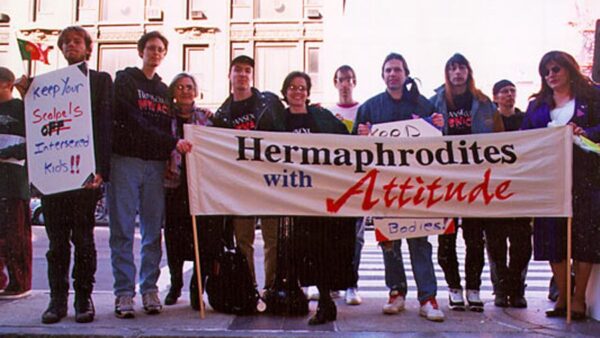
Though ISNA began as a support group, it quickly turned into an advocacy group because its members realized that they had suffered from similar problems. The organization produced a newsletter, “Hermaphrodites with Attitude” which connected thousands of intersex people for the first time. With the successes of the women’s health movement and the queer rights movements as a backdrop, people with intersex began agitating for openness and reform. ISNA supported the inquiries of researchers like Suzanne Kessler, Anne Fausto-Sterling, and Alice Dreger, and engaged in media outreach.
October 26, 1996 marks the anniversary of the first public demonstration by intersex people in the United States. ISNA members Morgan Holmes and Max Beck and transgender allies from the activist group “Transsexual Menace” arrived in Boston at the annual conference of the American Academy of Pediatrics. They shared their pain in a very public way, denouncing non-consensual infant genital surgeries and demanding the medical industry take notice. Doctors dismissed the activists as a vocal minority in a 1997 New York Times article covering the intersex action.
The “world’s first intersex retreat” was hosted in 1997 in Northern California, where the foundational short film “Hermaphrodites Speak!” was filmed. ISNA captured on film the origins of the intersex movement, and many people spoke out for the first time ever about the medical harms they’d experienced.
Intersex people increasingly found each other via the now-well-connected internet. Betsy Driver was one such intersex person, finding an entire community after buying a computer in 1999. In 2003, Betsy Driver and Emi Koyoma determined that intersex people needed a day to raise awareness. They picked the anniversary of the first intersex protest and declared October 26th 2004 as the first Intersex Awareness Day. It was picked up in the news, and soon people planned events internationally.
Accomplishments of the modern intersex movement
In the thirty years since the origins of the intersex movement, over 100 organizations were founded locally within the United States and worldwide to advocate for intersex rights and oppose nonconsensual surgeries. interACT was founded in 2006 by attorney Anne Tamar-Mattis with a focused mission of ending harmful medical interventions on intersex children. It took over the work of ISNA when its doors closed in 2008.
Researchers increasingly found nonconsensual surgeries to be harmful, and that intersex people do better when offered affirming healthcare, supportive families, and bodily autonomy. Medical professionals increasingly support intersex people’s right to decision-making over their bodies, as intersex education has started to be introduced in medical schools and textbooks.
The LGBTQ+ movement’s acceptance of Intersex (now the “I” in LGBTQIA) also increased visibility of intersex struggles. Intersex activists connected their oppression to the LGBTQIA rights movement due to expectations about their sexuality or gender.
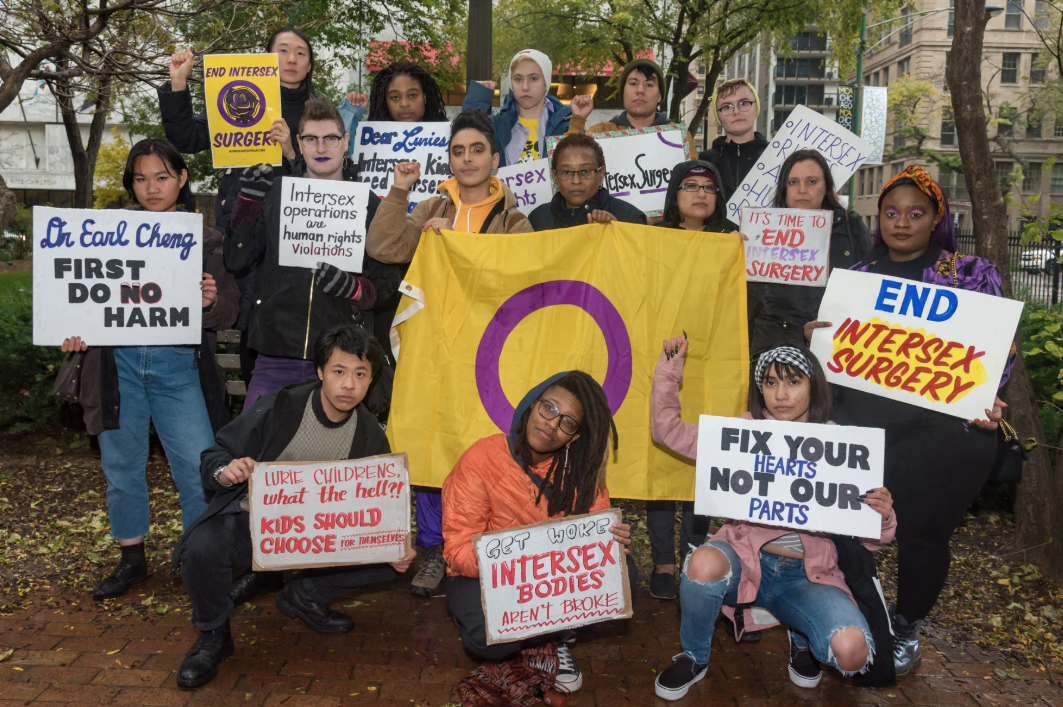
In 2016, activists with the Intersex Justice Project worked alongside interACT’s legal team and other intersex advocates to pressure Lurie Children’s Hospital of Chicago to change their policies. Advocates Pidgeon Pagonis and Sean Saifa Wall planned a demonstration on Intersex Awareness Day. After years of protest, Lurie Children’s Hospital became the first hospital to pledge to cease the practice of intersex surgeries. In 2020, the institution finally issued an apology. In the years since, this is recognized as only a partial victory, as some surgeries (such as on children with CAH) continue.
In 2018, LGBT advocacy group Voices 4, intersex supermodel Hanne Gaby Odiele, Intersex Justice Project, and interACT teamed up in New York City to protest Dr. Dix Poppas, a leader in performing clitoral surgeries on minors, who came under fire for using vibrators on young intersex children to test his surgical results. Poppas faced no discipline and still practices at Cornell. In August 2018, he quoted that he “should have videotaped” the tests. Intersex activists continue to criticize Poppas to this day.
In 2021, the United States recognized Intersex Awareness Day for the first time. By 2022, the Department of State expressed that governments are responsible for protecting the human rights of intersex individuals, and pledged solidarity with intersex advocates and activists.
Anti-LGBTQ cultural backlash and the movement forward
Throughout the early to mid-2020s, intersex people have experienced much of the cultural backlash that transgender people have. The introduction of new laws and policies defining male and female as fixed and binary, and blocking people outside of the binary from bathrooms, sports, schools and more creates a significant threat to many intersex people, especially those who do not identify with the sex they were assigned at birth. Every bill introduced with the intention of ending gender-affirming care for transgender adolescents and adults also includes “exceptions” for intersex genital mutilation.
interACT finds power in knowing that intersex people have existed since the beginning of time and will exist until the end of time. The intersex movement, comprised of hundreds of organizations, continues to build momentum. No law, executive order, judge or advocate of pseudoscience can erase us. Through community, through advocacy, and through visibility, we carry on.
Books
- XOXY: A Memoir, by interACT Executive Director Kimberly Zieselman (2020)
- Born Both: An Intersex Life (2017)
- Contesting Intersex: The Dubious Diagnosis by former interACT Board President Georgiann Davis (2015)
- Bodies in Doubt: An American History of Intersex (2012)
- Fixing Sex: Intersex, Medical Authority, and Lived Experience (2008)
- Intersex (for Lack of a Better Word) (2008)
- Intersex & Identity: The Contested Self (2003)
- Hermaphrodites and the Medical Invention of Sex (2000)
Podcasts
- Outwords (Interviews with intersex elders 2017-current)
Media and Film
- Every Body (2023)
- Intersex and Faith documentary (2020)
- Intersexion documentary (2012)
- XXY Offers a New View of Life in an Intersex Body (Film review, 2008)
- Hermaphrodites Speak! (1997)
Archives
- ISNA.org archive – hub for all intersex advocacy information pre-2008
- In-person archive maintained by the Houston Intersex Society
- Hormel Center archives at the San Francisco Public Library
Articles, Reports, and Miscellaneous
- Revisiting the limits of professional autonomy: The intersex rights’ movements’ path to de-medicalization (2019)
- Making sense of ‘Intersex’ and ‘DSD’: how laypeople understand and use terminology (2018)
- Astrea Foundation’s Report on The State of Intersex Organizing (2nd Edition) (2017)
- Community Letter of Resignation from the Advocacy Advisory Network of the NIH Translational Research Network (2015)
- Intersex and Intrasex Debates: Building Alliances to Challenge Sex Discrimination (2006)
Featured Resource