

Trans and intersex athletes are increasingly being targeted for exclusion at every level of sport. In addition to rampant state legislation that discriminates against children who just want to play on teams with their friends at school, elite athletes are facing a cascade of exclusionary policies affecting their ability to compete on the international stage. World Athletics, the International Olympic Committee, and the US Olympic and Paralympic Committee (among others) have all recently chosen to enforce discriminatory restrictions that will bar transgender women, as well as many intersex women, from participation.
But the medical community is calling out this practice as unscientific, discriminatory, and a violation of privacy.
Such policies are typically tied to a single physical characteristic; in the past, athletes have commonly suffered exclusion based on their chromosomes or testosterone levels. Today, the new trend in athletic eligibility discrimination is based on a specific genetic factor known as the SRY gene. (Both World Athletics and the International Olympic Committee built their policies around this single gene.)
No matter which physical characteristic is used, these restrictions will be unscientific, harmful, and wrong. Decades of harrowing experiences endured by women athletes with variations in their sex characteristics are a testament to this already. An ever-increasing number of medical associations and science experts are explaining why they agree.
Medical experts oppose hormone, chromosome, and gene testing in athletics
We previously applauded the American Medical Association’s policy that opposed the use of hormone-based eligibility restrictions, mandatory “sex” testing, and coercive requirements that could pressure athletes into unwanted medical interventions to be allowed to compete. AMA Board Member David H. Aizuss, M.D. affirmed that such policies “contribute to discrimination and stigma attached to naturally occurring differences in gender and sexual identity, sexual development and orientation,” and that “[u]nnecessary medical interventions to change natural hormone variations as a prerequisite for athletic competition must not be forced” onto athletes with intersex traits.
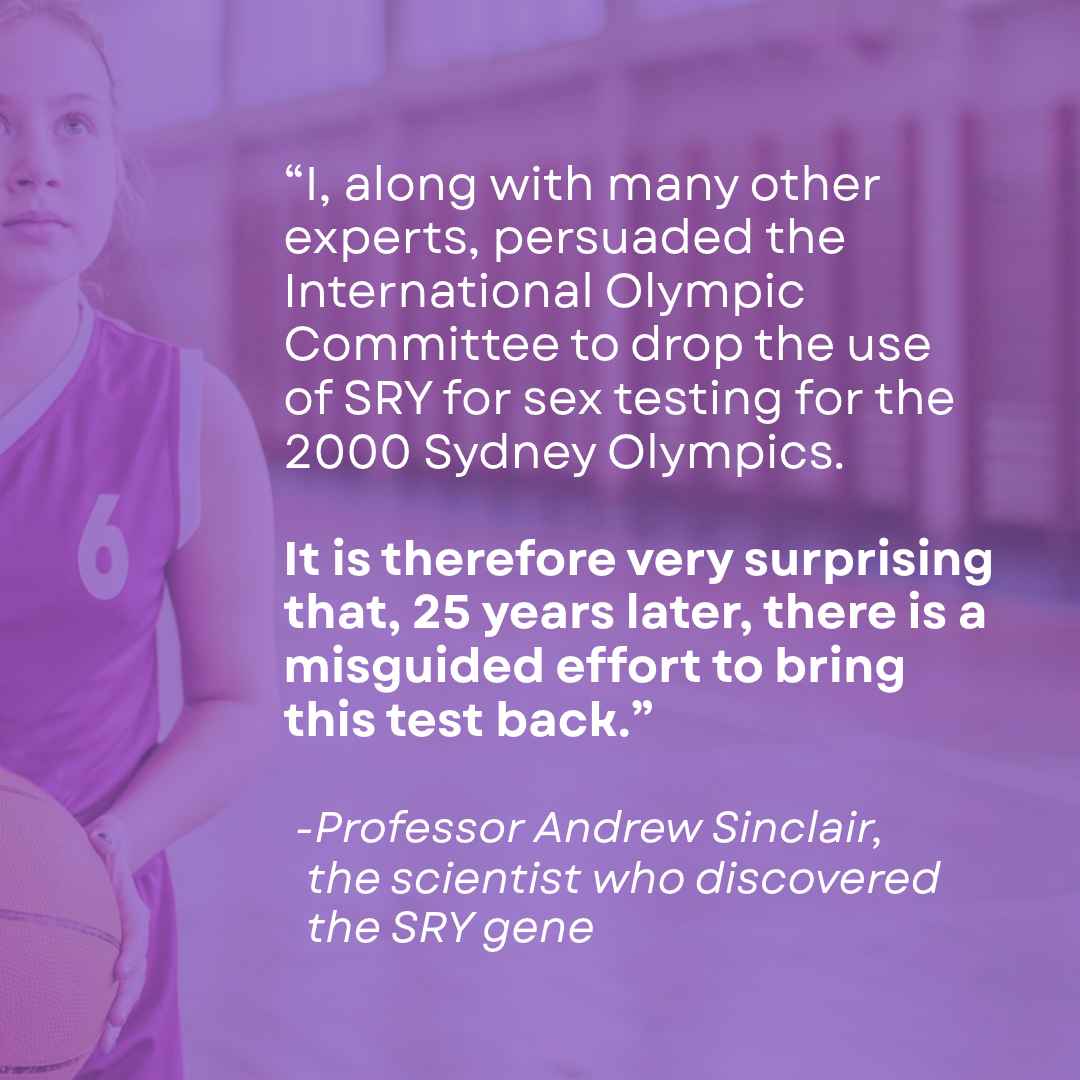
Professor Andrew Sinclair – the scientist who discovered the SRY gene – has strongly argued that this gene is not an adequate proxy for biological sex and “should not be used to exclude women athletes from competition.” He called World Athletics’ insistence on the singular importance of the SRY gene an “overly simplistic assertion” that “the science does not support,” and explained that “biological sex is much more complex, with chromosomal, gonadal (testis/ovary), hormonal and secondary sex characteristics all playing a role.” He recounted: “I, along with many other experts, persuaded the International Olympic Committee to drop the use of SRY for sex testing for the 2000 Sydney Olympics. It is therefore very surprising that, 25 years later, there is a misguided effort to bring this test back.”
A new call for the end to genetic testing in sports
The American College of Medical Genetics and Genomics (ACMG) has now condemned the new World Athletics and IOC policies as unethical and unscientific. The ACMG called for “the immediate suspension of any policy mandating SRY genetic testing for athletes,” pointing to the following reasons:
SRY testing is unscientific. The policies “demonstrate[] a lack of understanding of the complex mechanisms governing sex development.” “The presence or absence of the SRY gene or the Y chromosome alone is not sufficient to define male or female sex. … Relying on the sole presence of SRY oversimplifies sex determination, fails to account for clinical realities, and has not been shown to be directly associated with disproportionate competitive advantage among elite female athletes.” SRY testing therefore “enforces strict, medically inaccurate definitions of sex and discriminates against any athlete whose biology does not conform to narrow norms.”
There is no medical or competitive need for SRY testing. Requiring SRY screening for all athletes represents an “inappropriate use of genetic testing in the absence of a clinical indication.” “Using SRY testing for general athletic screening… is not clinically justified [and] provides no benefit to those tested.” Additionally, “[t]here is no evidence that the presence of SRY DNA sequences alone directly confers athletic performance advantage. Use of a diagnostic genetic test in the absence of clear scientific and medical justification is not ethical.”
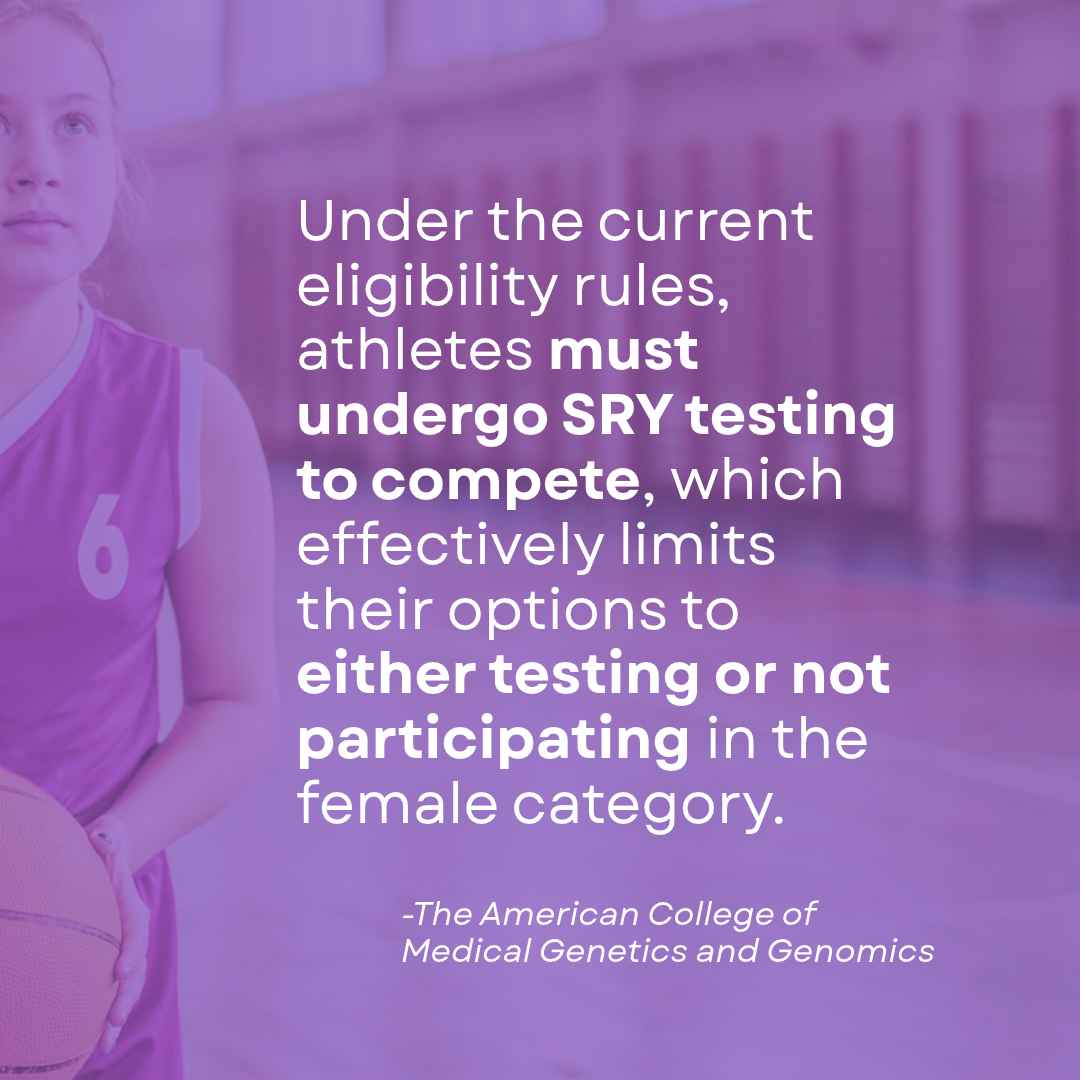
Forced SRY testing is coercive and unethical. “Informed consent is fundamental for ethical genetic testing, ensuring autonomy and respect for individuals. …Under the current eligibility rules, athletes must undergo SRY testing to compete, which effectively limits their options to either testing or not participating in the female category.” This forced choice raises ethical concerns about the “lack of informed, voluntary consent resulting in coercion of athletes” into testing.
SRY testing violates medical privacy. “Genetic testing results are generally recognized as protected medical information that cannot be disclosed without the individual’s permission or valid legal causes. Use of SRY results to determine athletic eligibility risks exposing sensitive information to third parties, violating athletes’ privacy.” Furthermore, “[t]he World Athletics and International Olympic Committee regulations do not address the need for proper pre-test counseling,” which “may result in psychological harm and mismanagement, particularly when the athletes encounter unexpected SRY testing results.”
Policies that attempt to define a person’s “sex” in narrow and arbitrary ways that negate their lived experience are an obvious threat to the rights and well-being of our communities. These policies additionally pose a threat to the values of scientific accuracy and medical ethics. When policymakers claim that discriminatory criteria are allegedly justified by adherence to “scientific evidence” or “biological truth,” it is important to remember how the representatives from these fields have responded: “Not in our names.”
A medical consensus is building against discriminatory policies and for medical privacy. Athletics governing bodies, take note.
For guidance on covering these and other harmful “sex testing” policies, see our Fact Sheet for Reporters in collaboration with GLAAD.